
Needlestick injuries are dangerous. They can also be costly for hospitals, clinics, care facilities, and home health workers and caregivers. Our SureReCap™ patented design is a simple safe solution to help reduce the risk of needlestick injuries.
RISKS

The US Occupational Safety and Health Administration (OSHA) estimates 5.6 million workers in the healthcare industry are at risk of occupational exposure to blood-borne diseases via percutaneous injury.[12] Needlestick injuries can lead to transmission of blood-borne diseases, placing those exposed at increased risk of infection from disease causing pathogens, such as:
- hepatitis B virus (HBV)
- hepatitis C virus (HCV)
- human immunodeficiency virus (HIV)
Among healthcare workers and laboratory personnel worldwide, more than 25 blood-borne virus infections have been reported to have been caused by needlestick injuries.[2]
Injuries commonly occur during needle recapping or via improper disposal of devices. Access to appropriate personal protective equipment and safety devices, such as SureReCap™, reduces the risk of occupational needlestick injuries.[2]
Generally, needlestick injuries cause only minor visible trauma or bleeding; however, even in the absence of bleeding the risk of viral infection remains.There are psychological effects as well as physical injuries with an occupational needlestick injury.
SOLUTIONS
SureReCap™ is a simple safe solution to help reduce the risk of needle stick injuries. Our SureReCap™ patented design securely holds the large outer cap of injection devices so that the needle can be recapped and disposed of without touching the needle.
Our SureReCap™ patented design for use with pen needles securely holds the large outer cap which allows the needle to be recapped, removed, and disposed of, without ever touching the needle.
SureReCap™ is a simple safe solution to help reduce the risk of needle stick injuries.
SureReCap™ is a patented solution developed for health care professionals as well as for individuals.
SureReCap™ capitalizes on the ”no-touch” protocols that eliminates direct contact with needles after use and disposal which can greatly reduce the risk of needlestick injuries.
SureReCap™ is reusable.
SureReCap™ is cost effective.
SureReCap™ is simple and easy to use.
Check out our Videos to see how easy it is to use SureReCap™.
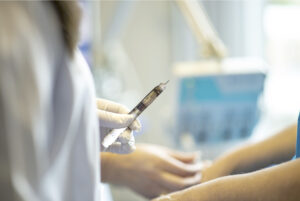
Needlestick injuries make up more than 80% of all percutaneous exposure incidents in the United States.[1][3] It is estimated that there are 3.5 million needlestick injuries each year. These estimates are considered low, it is estimated that half of all occupational needlestick injuries are not reported.[14][15]
These injuries can occur at any time when people use, disassemble, or dispose of needles. Many needle stick injuries occur when trying to replace the safety cap on the needle following the injection.
SureReCap™ is a simple safe solution to help reduce the risk of needle stick injuries. Our SureReCap™ patented design securely holds the large outer cap of needles so that the needle can be recapped, removed, and disposed of, without ever touching the needle. SureReCap™ capitalizes on the ”no-touch” protocols that eliminates direct contact with needles after use and disposal which greatly reduces the risk of needlestick injuries.
The American Hospital Association found that one case of infection by blood-borne pathogens could cost $1 million for testing, follow-up, and disability payments. It is estimated hospitals could save $1 billion annually by preventing needlestick injuries among healthcare workers in the US, including fees associated with testing, laboratory work, counseling, and follow-up costs.[17]
Find out today how SureReCap™ can help protect your workers and save your hospital, clinic, or care facility money.
SureReCap™ HOSPITAL BENEFITS
Hospitals using safety-precautions, such as SureReCap™, can result in not only protecting your healthcare workers, but it can lead to substantial savings by reducing the risk of needlestick injuries.
The American Hospital Association found that one case of infection by blood-borne pathogens could cost $1 million for testing, follow-up, and disability payments.
It is estimated hospitals could save $1 billion annually by preventing needlestick injuries among healthcare workers in the US, including fees associated with testing, laboratory work, counseling, and follow-up costs.[17]
Find out today how SureReCap™ can help protect your workers and save your hospital money.
SureReCap™
Read more about the COSTS OF NEEDLESTICK INJURIES in our article “Needlestick injuries are costly.”
References
1. “The National Surveillance System for Healthcare Workers (NaSH) Summary Report for Blood and Body Fluid Exposure (1995–2007)” (PDF). CDC. 2011. Archived (PDF) from the original on 22 June 2017. Retrieved 10 September 2017.
2. Tarigan, Lukman H.; Cifuentes, Manuel; Quinn, Margaret; Kriebel, David (1 July 2015). “Prevention of needle-stick injuries in healthcare facilities: a meta-analysis”. Infection Control and Hospital Epidemiology. 36(7): 823–29. doi:10.1017/ice.2015.50. ISSN 1559-6834. PMID 25765502.
3. Leigh, JP; Markis, CA; Iosif, A; Romano, PS (2015). “California’s nurse-to-patient ratio law and occupational injury”. International Archives of Occupational and Environmental Health. 88 (4): 477–84. doi:10.1007/s00420-014-0977-y. PMC 6597253. PMID 25216822.
4. Alamgir, H; Yu, S (2008). “Epidemiology of occupational injury among cleaners in the healthcare sector”. Occupational Medicine. 58 (6): 393–99. doi:10.1093/occmed/kqn028. PMID 18356143.
5. “Stop Sticks – NIOSH”. www.cdc.gov. Archived from the original on 15 July 2017. Retrieved 27 February 2016.
6. Phillips, EK; Conaway, M; Parker, G; Perry, J; Jagger, J (2013). “Issues in Understanding the Impact of the Needlestick Safety and Prevention Act on Hospital Sharps Injuries”. Infection Control and Hospital Epidemiology. 34 (9): 935–39. doi:10.1086/671733. PMID 23917907.
7. Parantainen, Annika; Verbeek, Jos H.; Lavoie, Marie-Claude; Pahwa, Manisha (1 January 2011). “Blunt versus sharp suture needles for preventing percutaneous exposure incidents in surgical staff”. The Cochrane Database of Systematic Reviews (11): CD009170. doi:10.1002/14651858.CD009170.pub2. ISSN 1469-493X. PMC 7387125. PMID 22071864.
8. Office, U. S. Government Accountability (17 November 2000). “Occupational safety: Selected cost and benefit implications of needlestick prevention devices for hospitals” (GAO-01-60R). United States General Accounting Office. Archived from the original on 4 March 2016. Retrieved 30 October 2015.
9. Reddy, V (2017). “Devices for preventing percutaneous exposure injuries caused by needles in healthcare personnel”. Cochrane Database Syst Rev. 11: CD009740. doi:10.1002/14651858.cd009740.pub3. PMC 6491125. PMID 29190036.
10. Makary, MA; Al-Attar, A; Holzmueller, CG; Sexton, JB; Syin, D; Gilson, MM; Sulkowski, MS; Pronovost, PJ (2007). “Needlestick Injuries among surgeons in training”. The New England Journal of Medicine. 356 (26): 2693–99. doi:10.1056/NEJMoa070378. PMID 17596603.
11. Elmiyeh, B; Whitaker, IS; James, MJ; Chahal, CA; Galea, A; Alshafi, K (July 2004). “Needle-stick injuries in the National Health Service: a culture of silence”. Journal of the Royal Society of Medicine. 97 (7): 326–27. doi:10.1258/jrsm.97.7.326. PMC 1079524. PMID 15229257.
12. Kirchner, B (2012). “Safety in ambulatory surgery centers: Occupational Safety and Health Administration surveys”. AORN Journal. 96(5): 540–45. doi:10.1016/j.aorn.2012.08.010. PMID 23107034.
13. Lavoie, M; Verbeek, JH; Pahwa, M (2014). “Devices for preventing percutaneous exposure injuries caused by needles in healthcare personnel”. The Cochrane Database of Systematic Reviews. 3 (3. Art. No.: CD009740): CD009740. doi:10.1002/14651858.CD009740.pub2. PMID 24610008.
14. Laramie, AK; Davis, LK; Miner, C; Pun, VC; Laing, J; DeMaria, A (March 2012). “Sharps injuries among hospital workers in Massachusetts, 2010: findings from the Massachusetts Sharps Injury Surveillance System”(PDF). Massachusetts Department of Public Health. Archived (PDF) from the original on 8 May 2016. Retrieved 23 February 2016.
15. Boden, LI; Petrofsky, YV; Hopcia, K; Wagner, GR; Hashimoto, D (2015). “Understanding the hospital sharps injury reporting pathway”. American Journal of Industrial Medicine. 58 (3): 282–89. doi:10.1002/ajim.22392. PMC 5077298. PMID 25308763.
16. Patterson, JM; Novak, CB; Mackinnon, SE; Patterson, GA (1998). “Surgeons’ concern and practices of protection against bloodborne pathogens”. Annals of Surgery. 228 (2): 266–72. doi:10.1097/00000658-199808000-00017. PMC 1191469. PMID 9712573.
17. Anderson JM (2008). “Needle stick injuries: prevention and education key. (Clinical report)”. Journal of Controversial Medical Claims. 15: 12.